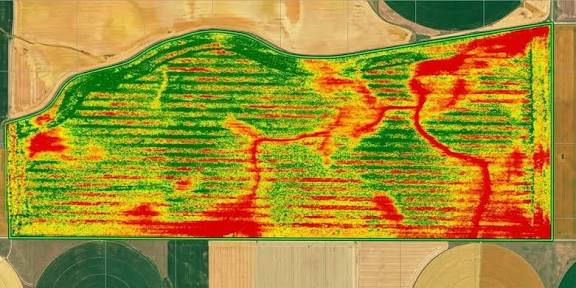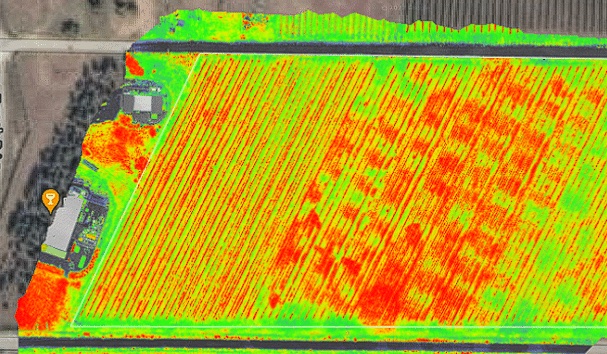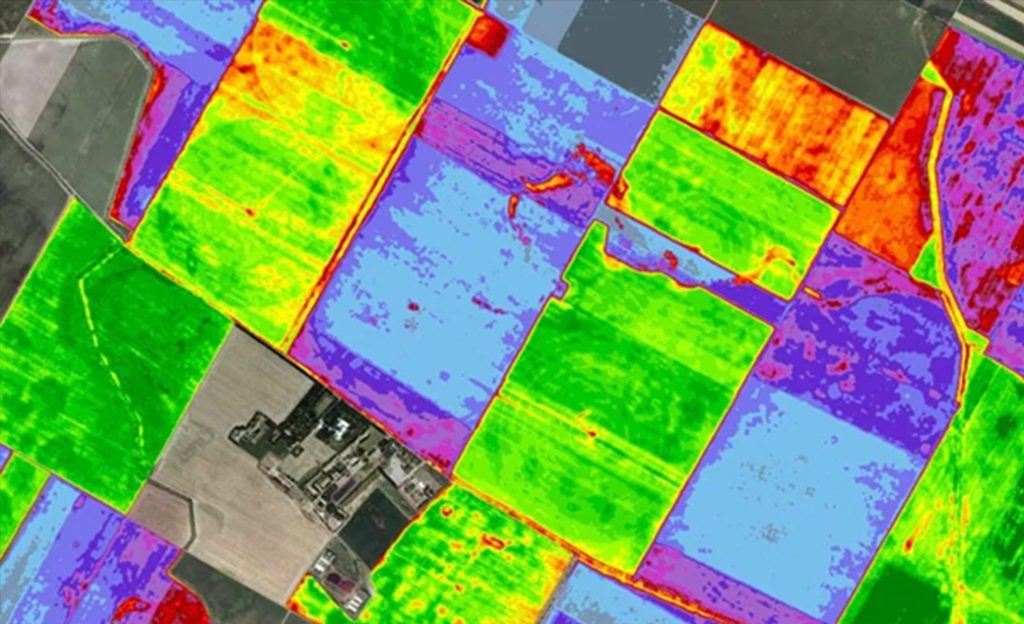
A single NDVI image at peak season really is linked to yield. But the link isn’t perfect: on real fields one index explains about half of the yield variance, not all of it. Let’s unpack where the ceiling comes from and what raises it.
Why one index hits a ceiling
A vegetation index sees “greenness” and biomass. That’s enough to tell a strong zone from a weak one, but not enough to predict tonnes per hectare:
- with a dense canopy the index saturates and stops distinguishing “good” from “very good”;
- it doesn’t separate the cause: nitrogen hunger, water stress and disease all look like a similar drop;
- it depends on the acquisition date and phenology, and cloud-free images arrive irregularly.
In the published remote-sensing yield literature, a single index usually correlates with yield at around R² 0.5-0.6. Useful for ranking fields, weak for a budget.
What a calibrated stack adds
Accuracy rises when independent sources and ground data are added to one index:
- the red edge (NDRE) for nitrogen status, separately from overall biomass;
- SWIR and radar for moisture and canopy structure, to separate drought from hunger and keep watch under clouds;
- hyperspectral for leaf biochemistry where depth is needed;
- phenology over time, not one image, but a development curve across the season;
- ground calibration against your own yield and soil measurements.
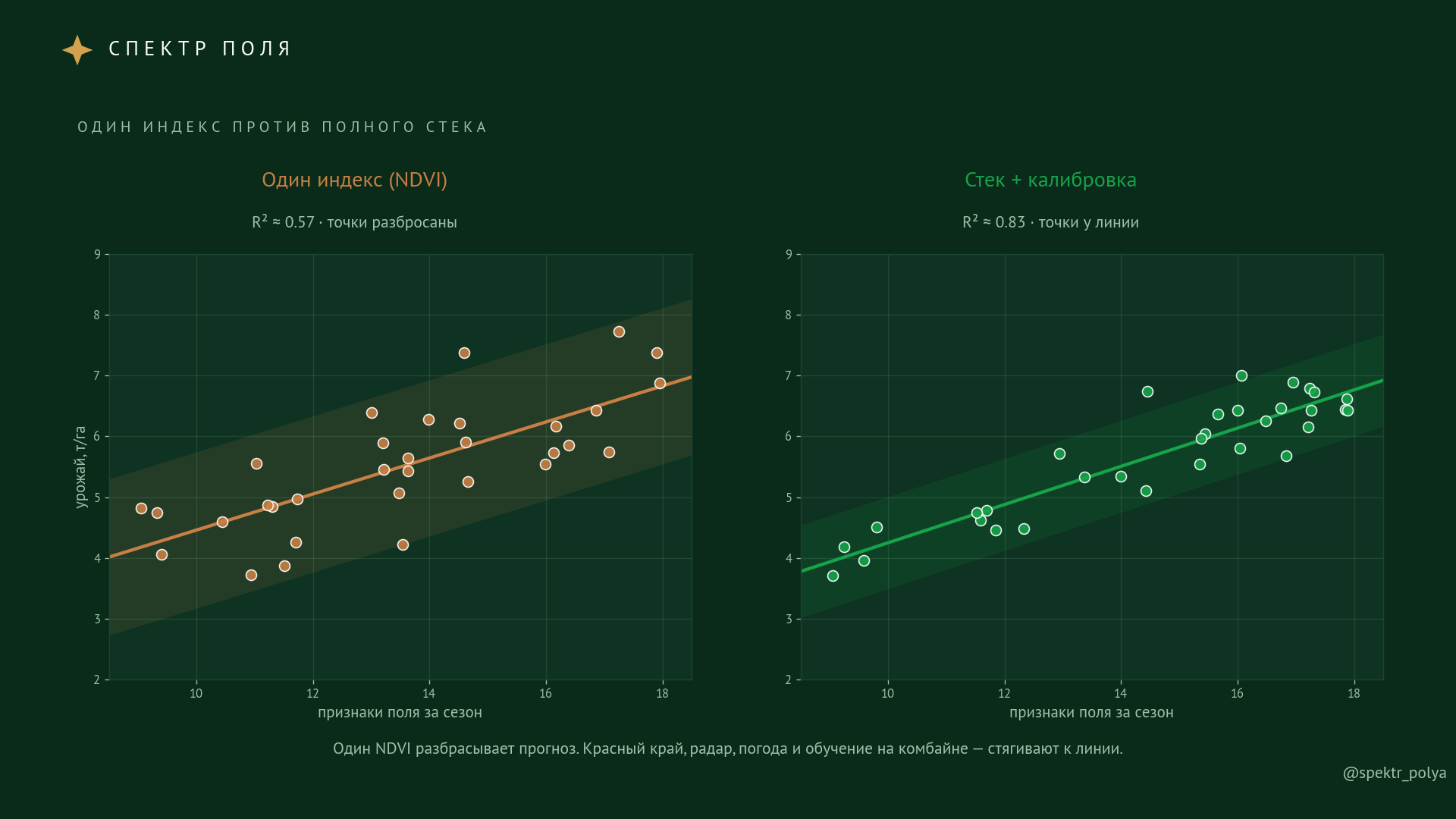
Across published multi-factor and calibrated models, R² rises into roughly the 0.8-0.9 range. That’s a level you can lean on for harvest planning and logistics.
Where the honest limit is
These figures are ranges from the literature, not a guarantee for your field. Accuracy depends on the crop, the region and the volume of ground data. So we give a quantitative estimate with a tolerance until there’s calibration for a specific farm, and we calibrate the model on your data rather than passing off someone else’s percentages as yours. A forecast is a decision tool, not a promise of an exact number.